

What's changed: Deepened AZ-700 Chapter 3 (ja figures; comparison tables/scenarios/FAQ/traps/deep paragraphs in all sections)
3.3BGP and Route Propagation
Understand BGP for dynamically exchanging routes between on-prem and Azure, route propagation over VPN/ExpressRoute, and route-selection precedence. Dynamic routing reduces manual route configuration.
Managing routes manually across many sites is hard. With BGP, on-prem and Azure dynamically learn and exchange routes, reducing manual effort and errors.
3.3.1Dynamic routing and precedence
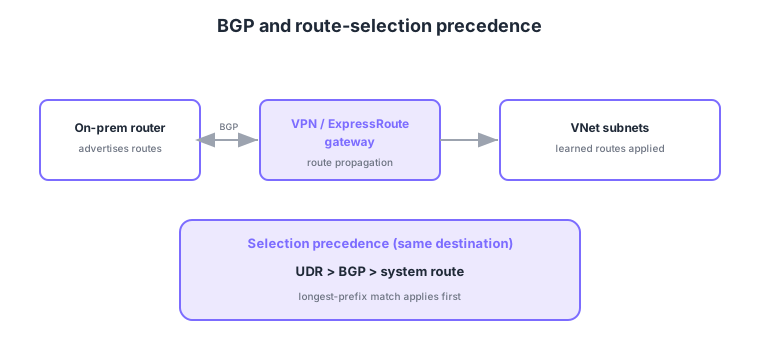
- BGP: the standard protocol to dynamically exchange routes between on-prem and the Azure gateway.
- Route propagation: routes learned via VPN/ExpressRoute are propagated into the VNet through the gateway.
- Selection precedence: for the same destination, UDR > BGP > system route; longest-prefix match filters first.
- Disable propagation: disabling gateway route propagation on a route table helps enforce forced tunneling, etc.
Common on AZ-700: dynamic route exchange = BGP, learned routes into the VNet = route propagation, same-destination precedence = UDR > BGP > system (longest-prefix match first). Distinguish designs that prefer manual UDRs vs those using BGP for scalability.
BGP identifies peers by Autonomous System Number (ASN). Azure’s VPN/ExpressRoute gateways use default ASN 65515, while on-prem sets its own ASN (some reserved ASNs are disallowed). Enabling BGP on a VPN exchanges routes over the tunnel via BGP peer IPs, so added on-prem subnets are learned automatically without editing UDRs. ExpressRoute always exchanges routes via BGP—private peering advertises VNet prefixes, Microsoft peering advertises public prefixes. When both an ExpressRoute and a VPN route exist for the same destination, Azure by default prefers ExpressRoute (the basis for backup-VPN designs). For segments where you want to ignore learned routes, disable gateway route propagation on the route table so only UDRs apply. Summarizing advertised prefixes to stay under route-count limits is another practical point. BGP governs route reachability and is distinct from allow/deny (NSG) and inspection (NVA/Firewall).
| Aspect | Static (UDR) | Dynamic (BGP) |
|---|---|---|
| Route management | Manually define dest → next hop | Auto-exchanged between gateways |
| Adding sites | Edit UDRs by hand | Learned/propagated automatically |
| Precedence | Highest (UDR > BGP at equal length) | Above system, below UDR |
Scenario: on-prem sites change often and editing UDRs each time is burdensome. → Enable BGP on the VPN/ExpressRoute, set the on-prem router’s ASN, and exchange routes dynamically. Subnet changes propagate to Azure automatically, removing UDR edits; keep UDRs only for must-win exceptions.
FAQ: Q. If both ExpressRoute and VPN learn the same destination, which is used? → A. ExpressRoute is preferred by default (VPN suits backup). Q. What ASN does the Azure gateway use? → A. 65515 by default; set your own ASN on-prem and avoid reserved ASNs.
Trap: “BGP routes always beat UDRs” is wrong—at equal prefix length the order is UDR > BGP > system, so the UDR wins. Also “using BGP removes the need for NSG allow rules” is wrong—BGP is about reachability (routing); allow/deny still requires an NSG.
3.3.2Section summary
- BGP = dynamic route exchange; route propagation over VPN/ExpressRoute
- Precedence = UDR > BGP > system (longest-prefix match first)
Sign in to track progress — Log in.
Quick check
(just a quick review)Q1. Which standard protocol dynamically exchanges routes between on-prem and the Azure gateway?
Q2. When a UDR, a BGP route, and a system route exist for the same destination, which wins?
Q3. What is the mechanism that reflects routes learned via VPN/ExpressRoute into VNet subnets called?
Keep track of your progress
The full study guide is free to read. Sign up free to practice with the question bank, track what you have read, review your mistakes, and highlight passages.