

What's changed: Deepened AZ-305 Chapter 3 (added comparison tables, scenarios, FAQs, exam traps, deep-dive paragraphs to each section; localized figures to Japanese)
3.3Designing Disaster Recovery
Understand DR design—Azure Site Recovery (ASR), region pairs, RTO/RPO, and database geo-replication/failover groups. Design strategies to recover from regional failures.
For regional failures, prepare with cross-region replication and failover. ASR for VMs; geo-replication for databases.
3.3.1DR means and metrics
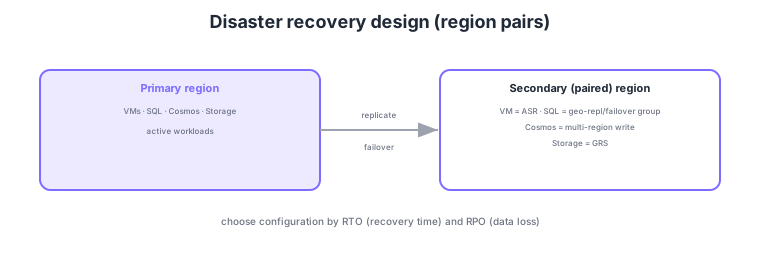
- Azure Site Recovery (ASR): continuously replicate VMs to another region with failover/failback.
- Region pairs: replicate to a geographically distant paired region for regional disasters.
- DB geo-replication: SQL uses active geo-replication/failover groups; Cosmos uses multi-region writes.
- RTO/RPO: RTO = recovery time, RPO = data loss; requirements drive the DR setup (replication/standby).
Common on AZ-305: cross-region VM DR = Azure Site Recovery, cross-region SQL DR = active geo-replication/failover groups, Cosmos multi-region writes, storage geo-redundancy = GRS, and choose setup by RTO/RPO. Failover groups auto-fail over without changing connection strings.
AZ-305 DR design probes "which replication and failover method meet the RTO/RPO requirement." RPO (recovery point objective) is tolerable data loss; RTO (recovery time objective) is tolerable time to recover—the tighter they are, the more always-on standby (cost) is needed. Azure Site Recovery (ASR) continuously block-level replicates VMs to another region and performs ordered failover via recovery plans (validated non-disruptively with test failover) and failback. For databases, Azure SQL Database offers active geo-replication (readable secondary) and failover groups (auto/manual failover via a listener without changing connection strings), and SQL Managed Instance supports failover groups. Cosmos DB uses multi-region writes (multi-master) so each region accepts writes, driving RPO/RTO near zero. Storage replicates cross-region with GRS/RA-GRS and promotes via account failover. Select regions based on Azure region pairs (favored for sequential maintenance and recovery prioritization). DR strategy spans, like AWS, backup & restore < pilot light < warm standby < active/active, chosen by the RTO/RPO-vs-cost trade-off, and validated with periodic failover drills.
| Target | Cross-region DR means | Key point |
|---|---|---|
| Virtual machines | Azure Site Recovery (ASR) | Continuous replication; recovery plans |
| Azure SQL Database | Failover groups / geo-replication | Auto-failover without changing connection strings |
| Cosmos DB | Multi-region writes | Writable in each region; near-zero RPO/RTO |
| Storage | GRS/RA-GRS | Cross-region replica; account failover |
Scenario: Recover a core app (IaaS VMs + Azure SQL Database) to another region within minutes of RTO and minutes of RPO even on a regional failure. → Continuously replicate VMs to another region with ASR, defining boot order in a recovery plan (validated via test failover). Replicate the DB cross-region with a failover group, switching via the listener without changing connection strings. Choose a region pair and run periodic failover drills.
FAQ: Active geo-replication vs failover groups? Both replicate Azure SQL cross-region, but failover groups provide a listener (read-write/read-only endpoints) and group-level auto/manual failover without changing connection strings. Active geo-replication is the finer-grained mechanism creating a readable secondary per database. For operational simplicity, failover groups are the go-to.
Exam trap: Handling cross-region VM disaster recovery with Azure Backup alone is a weak design—Backup is restore from recovery points and tends to have a long RTO. For low-RTO cross-region failover, ASR (continuous replication) fits. Also, thinking of Cosmos DB DR as the same "failover groups" as SQL is wrong—Cosmos centers on multi-region writes.
3.3.2Section summary
- VM = ASR (cross-region replication/failover) / DB = geo-replication
- Metrics = choose setup by RTO (recovery time)/RPO (data loss)
Sign in to track progress — Log in.
Quick check
(just a quick review)Q1. Continuously replicate VMs to another region and fail over on disaster. What?
Q2. Replicate Azure SQL Database to another region and auto-fail over without changing connection strings. What?
Q3. Which are the two key metrics when choosing a DR configuration?
Keep track of your progress
The full study guide is free to read. Sign up free to practice with the question bank, track what you have read, review your mistakes, and highlight passages.