

What's changed: Deepened ANS-C01 Chapter 3 (Traffic Flow/health-check types, two edge function types/cache key, GA internals/dial + tables, scenarios, FAQ, traps; ja figures)
3.3Global Accelerator and Choosing Edge Services
The other edge—understand Global Accelerator, static anycast IPs, the AWS backbone, fast regional failover, and how it differs from CloudFront. Choose it for non-HTTP or static-IP needs.
Global Accelerator (GA) puts users onto the AWS backbone from the nearest edge to reach the target region with low latency. Unlike CloudFront it does not cache, and it provides two static anycast IPs.
3.3.1GA vs CloudFront
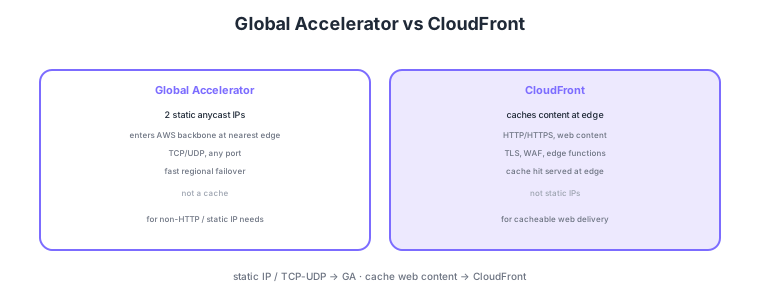
- Static anycast IPs: GA provides two fixed IPs, good when IPs must not change or for allow-lists.
- Protocols: supports TCP/UDP on any port (CloudFront is HTTP/HTTPS-centric).
- Fast failover: switch quickly to a healthy region on regional failure.
- No caching: GA does not cache; content caching is CloudFront’s job.
Common on ANS-C01: need static IPs / non-HTTP (TCP·UDP) = Global Accelerator, cacheable web delivery = CloudFront, GA gives low latency over the backbone + fast regional failover, and GA does not cache. They are complementary—choose by use case.
Both GA and CloudFront benefit from AWS Shield Standard DDoS mitigation, absorbing attacks at the edge.
ANS-C01 tests GA’s internals (listeners and endpoint groups) and the traffic dial. An accelerator has two static anycast IPs, under which sit listeners (port/protocol), then per-Region endpoint groups, each containing endpoints like ALB/NLB/EC2/EIP. An endpoint group has a traffic dial (0–100%) to cap the share sent to a healthy Region, and each endpoint has a weight for proportional distribution within the group. GA health-checks continuously, drops an unhealthy endpoint instantly, and steers traffic to a healthy Region while the anycast IP stays unchanged—giving second-scale failover independent of DNS TTL. That is why GA is chosen when "faster switching than Route 53 failover" is required. Port overrides let the public front-end port differ from the backend port. Versus an NLB: an NLB is L4 distribution within one Region, whereas GA spans Regions, routing to the optimal Region over the backbone.
| Aspect | Global Accelerator | Route 53 (DNS) |
|---|---|---|
| Switch mechanism | Fixed anycast IP, reroutes instantly | Changes the IP it answers |
| Failover speed | Seconds (TTL-independent) | Depends on TTL and resolver cache |
| IP the client sees | Always the same two IPs | May change per lookup |
| Layer | L4 (TCP/UDP, any port) | DNS resolution |
Scenario: IoT devices have fixed IPs allow-listed in firmware; connect them to multi-region NLBs without changing the IP, and on a regional outage shift to the survivor within seconds. → Put Global Accelerator in front of the NLBs and register its two static anycast IPs in the devices. Make each Region an endpoint group; health checks drop an unhealthy Region instantly. Fast failover with no DNS change and an unchanged IP.
FAQ: Q. Traffic dial vs weight? A. The dial caps total flow per endpoint group (Region) as a %, while weight distributes proportionally among endpoints within a group. Q. Does GA replace CloudFront? A. No—GA does not cache; it carries traffic to the optimal Region at L4. Cacheable web delivery is CloudFront’s domain, and the two can be combined.
Trap: "Global Accelerator caches content to speed up delivery" is false. GA does not cache. Its speed comes from getting onto the AWS backbone early at the edge to reach the optimal Region, plus TTL-independent fast failover—not caching. Cache-based acceleration is CloudFront’s job.
3.3.2Section summary
- Static IP/non-HTTP = Global Accelerator; web cache = CloudFront
- GA = backbone + fast failover (no caching)
Sign in to track progress — Log in.
Quick check
(just a quick review)Q1. Receive an online game’s UDP traffic globally with low latency on fixed IP addresses. What?
Q2. Which correctly states a difference between Global Accelerator and CloudFront?
Q3. In a multi-region setup, quickly switch clients to a healthy region on regional failure while keeping the IP fixed. What?
Keep track of your progress
The full study guide is free to read. Sign up free to practice with the question bank, track what you have read, review your mistakes, and highlight passages.