

What's changed: Deepened AI-900 Chapter 5 to the AZ-900 baseline (pretraining + three tuning levels prompt/RAG/fine-tune, generative model types, Azure OpenAI models/Studio/embeddings, Copilot product examples, Content Safety/prompt injection, FAQ)
5.1Generative AI and Large Language Models
Understand what generative AI is, how large language models (LLMs) work, and core concepts—prompts, completions, and tokens.
Generative AI creates new content—text, images, code—from patterns learned in large datasets. Where traditional AI focuses on "classify/predict (pick an existing answer / estimate a number)," generative AI fundamentally "creates." For AI-900, grasp its specific terms and mechanism.
5.1.1Large language models (LLMs)
A large language model (LLM) is trained on vast text and generates language by predicting the next word (token) probabilistically. Your instruction or question is the prompt; the model’s output is the completion. LLMs are built on the Transformer deep-learning architecture, generating natural continuations from context.
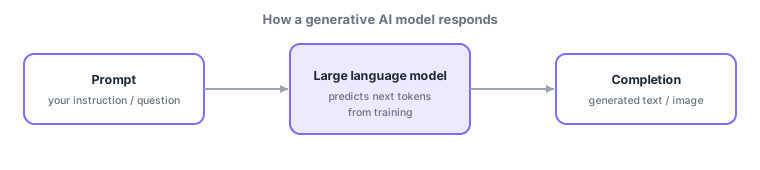
- Prompt: the input (instruction/question) to the model. Crafting prompts to improve output is prompt engineering.
- Completion: the generated result the model returns.
- Token: the unit of text the model processes (roughly part of a word); it underlies cost and input length (context window).
- Foundation model: a large pretrained model usable across many tasks (e.g., GPT).
- Multimodal: a model handling multiple types—text plus images, audio, etc.
Continue reading — free sign-up
You're reading the free preview. Sign up free to read this section in full, plus every chapter (including 4+) and all questions.