

What's changed: Deepened AI-900 Chapter 3 to the AZ-900 baseline (how CV works = pixels/deep learning, segmentation/spatial analysis, resource creation with key+endpoint, Custom Vision project types, FAQ)
3.2Azure Computer Vision Services
Understand Azure’s computer vision services—Azure AI Vision, Face, and Custom Vision—and when to use each.
Azure offers services to use computer vision without building your own model. Most are part of Azure AI services (formerly Cognitive Services) and work by calling an API. The mental model is simple: first decide whether a prebuilt model suffices; if not, move to custom training.
3.2.1Key services
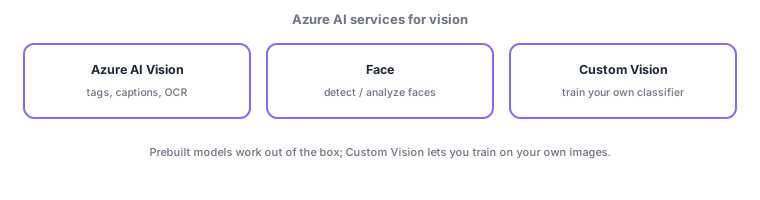
- Azure AI Vision: prebuilt general analysis—tags, captions, object detection, and OCR (Read).
- Face: specialized in detecting and analyzing faces (some features like identity verification are gated/restricted for Responsible AI).
- Custom Vision: train on your own images to build custom classifiers and object detectors (works with modest data).
| Service | Type | Good for |
|---|---|---|
| Azure AI Vision | Prebuilt (general) | General tags/captions/OCR |
| Face | Prebuilt (faces) | Face detection/analysis |
| Custom Vision | Custom training | Domain-specific classification/detection |
3.2.2Using the services and resources
To use these services, you first create a resource in the Azure portal and point your app at the issued key (authentication) and endpoint (connection URL). Azure AI services can be created per-feature, or as a multi-service resource that covers several features under one key. Custom Vision is a bit different: when you create a project you choose "classification" or "object detection," then upload and tag your images → train → publish to grow a custom model. None of these require server setup; all are pay-as-you-go.
Scenario: visual inspection on a manufacturing line. You want to flag "scratches/stains" from photos, but the defects are product-specific, so a general model is not accurate enough → train Custom Vision on your good/defective images. For document OCR or general tagging, Azure AI Vision suffices. Choose by whether the need is "domain-specific."
Watch the mix-ups: (1) Azure AI Vision (general, prebuilt: tags/captions/OCR/general object detection) vs Custom Vision (custom training on your data)—use Custom Vision for domain-specific categories. (2) Face (face-specialized) differs from general Vision’s face features. (3) These are part of Azure AI services, used via API key + endpoint (no model building).
Q. Azure AI Vision can do object detection, so why Custom Vision? Azure AI Vision detects general objects (person, car, chair) out of the box. But categories a general model has never seen—"our product A vs B," "a specific defect pattern"—require training your own images in Custom Vision. Q. What are the key and endpoint for? The key authenticates you as a legitimate caller; the endpoint is the URL telling which service/region to connect to. Q. Why are some Face features restricted? Face data is sensitive, so for Responsible AI some features (e.g., identity verification) are gated behind an application process.
Common mappings: general image analysis/OCR = Azure AI Vision, faces = Face, your own classifier/detector = Custom Vision. Choose prebuilt vs. custom based on need.
3.2.3Section summary
- Azure AI Vision = general analysis/OCR, Face = faces, Custom Vision = custom training (classification/detection)
- First check if prebuilt suffices; if not, train custom with Custom Vision
- Most are part of Azure AI services, used via API (key + endpoint)
Sign in to track progress — Log in.
Quick check
(just a quick review)Q1. Which Azure service fits training your own image classifier on your product photos?
Q2. Which service provides general analysis like tagging/captioning images and reading text?
Q3. Which Azure service specializes in detecting and analyzing faces in images?
Q4. Which correctly describes choosing prebuilt vs. Custom Vision?
Q5. How are these vision services generally consumed?