

What's changed: Deepened SOA-C02 Chapter 5 to Associate depth (tables, scenarios, FAQ, traps; localized figures)
5.2Route 53 and DNS Routing
Understand Route 53 hosted zones and records, health checks, and choosing routing policies (failover/latency/geolocation/weighted/simple).
Amazon Route 53 controls which endpoint a domain name resolves to. Choosing the right routing policy for the requirement is the operational point.
5.2.1Routing policies
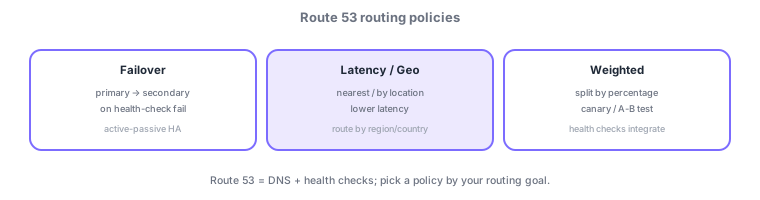
- Failover: switch to secondary on primary failure via health checks (active-passive).
- Latency/Geo: route to the lowest-latency region or by geographic location.
- Weighted: split traffic by percentage (canary/A-B test). Simple is a single record.
- Health checks: monitor endpoint health and integrate with failover, etc.
Route 53 is "DNS + health checks"; pick a routing policy by requirement. Simple is a single record (multiple values returned in no particular order); failover switches to a secondary on primary failure via health checks (active-passive); latency routes to the lowest-latency region; geolocation routes by the user’s country/region; geoproximity uses location plus a bias; weighted splits traffic by percentage (canary/A-B). For AWS resources (ALB/CloudFront/S3 website) use Alias records (work at the zone apex, no extra charge); use CNAME for external targets. The key to availability is health checks (endpoint, calculated, or CloudWatch-alarm based), integrated with failover and "drop unhealthy targets." A small TTL speeds switchover but increases queries. DNS propagates eventually, so design with TTL in mind.
Continue reading — free sign-up
You're reading the free preview. Sign up free to read this section in full, plus every chapter (including 4+) and all questions.