

What's changed: Service coverage: added catalog sections (s4 compute/DB/storage/network, s5 analytics/ML/IoT/media/integration)
2.2Scalable, Loosely Coupled Architectures
Understand elasticity and decoupling—Auto Scaling/ELB, decoupling with SQS/SNS/EventBridge, serverless (Lambda/API Gateway/Step Functions), and caching. Handle demand swings and contain failures.
Large-scale design hinges on loose coupling and horizontal scaling. Decouple components with queues/events and follow demand with Auto Scaling.
2.2.1Decoupling and scaling
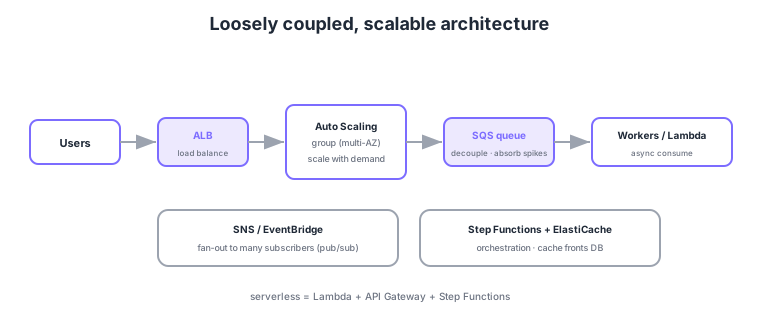
- Auto Scaling + ELB: spread across AZs and scale horizontally with demand; improves fault tolerance.
- SQS: decouple producer/consumer via a queue; absorb spikes and improve reliability with retries.
- SNS/EventBridge: fan out events to multiple subscribers (pub/sub, event-driven).
- Serverless: event-driven processing without managing servers via Lambda/API Gateway/Step Functions.
Common on SAP-C02: absorb spikes / decouple producer-consumer = SQS, one-to-many fan-out = SNS/EventBridge, demand-following horizontal scale = Auto Scaling, workflow orchestration = Step Functions. Replacing synchronous, tightly coupled calls with async queues/events improves resilience.
Use SQS FIFO when ordering/dedup is required; EventBridge (rules/targets) for large fan-out and event routing. Front read-heavy databases with ElastiCache.
The crux of loose coupling is replacing synchronous tight calls with asynchronous queues/events. SQS has standard (high throughput, at-least-once, no ordering) and FIFO (ordering, dedup), made reliable with visibility timeout, DLQ (dead-letter queue), and long polling. One-to-many uses SNS (push pub/sub) or EventBridge (an event bus + rules for attribute-based routing, SaaS/schedule integration, schema registry); SNS+SQS fan-out (buffer in per-subscriber SQS) is also common. Scale with Auto Scaling (target-tracking/step/predictive across AZs) + ELB (ALB = L7/path-based, NLB = L4/ultra-low-latency/static IP). Serverless = Lambda (concurrency; reserved/provisioned concurrency to ease cold starts) + API Gateway + Step Functions (Standard/Express; state/retries/branching). Reduce read load with ElastiCache (Redis/Memcached, cache-aside). On SAP, the go-to is “make tightly coupled synchronous processing asynchronous and loosely coupled with SQS/SNS/EventBridge to absorb spikes, localize partial failures, and improve resilience via retries.”
| Service | Model | Best for |
|---|---|---|
| SQS | Queue (one consumer group) | Absorb spikes, decouple producer/consumer |
| SNS | Push pub/sub | Fan out one event to many |
| EventBridge | Event bus + routing | Attribute routing, SaaS/schedule |
| Step Functions | State machine | Orchestrate multi-step with retries |
Scenario: deliver an order event to three independent services (inventory, billing, notifications), each processing at its own pace without dropping anything on failure. → Fan out with EventBridge (or SNS) and place an SQS queue in front of each service for buffering, retries, and a DLQ. Workers follow demand via Auto Scaling/Lambda.
FAQ: Q. SQS vs SNS? → A. SQS is a queue (consumers pull; one group processes); SNS is pub/sub (push one message to many). Combining them for fan-out + buffering is common. Q. SQS standard vs FIFO? → A. Standard is high-throughput but unordered and at-least-once; FIFO guarantees ordering + dedup (with throughput limits).
Trap: “use a single standard SQS queue to deliver one event to multiple services simultaneously” is wrong—one queue is consumed by a single group; fan-out needs SNS/EventBridge (+ per-subscriber SQS if buffering). Also “standard SQS suffices for ordering” is wrong—ordering needs FIFO.
2.2.2Section summary
- Decoupling = SQS (queue) / SNS·EventBridge (fan-out)
- Scale = Auto Scaling + ELB / serverless = Lambda/API GW/Step Functions
Sign in to track progress — Log in.
Quick check
(just a quick review)Q1. You want to decouple an order-intake front end from slow processing workers so spikes never drop requests. What?
Q2. You want one event delivered simultaneously to several services (email, logging, analytics). What?
Q3. You want to orchestrate a long-running workflow of multiple Lambdas with state, retries, and branching. What?
Keep track of your progress
The full study guide is free to read. Sign up free to practice with the question bank, track what you have read, review your mistakes, and highlight passages.