

What's changed: Service coverage: added a catalog section (s4) for governance/security/end-user services
1.1Multi-Account Strategy and Governance
Understand the foundation for large organizations: AWS Organizations, Organizational Units (OUs), Service Control Policies (SCPs), consolidated billing, and Control Tower. Operate many accounts securely and with governance.
At the professional level, governing many accounts is central. AWS Organizations groups accounts into a hierarchy with centralized guardrails and billing.
1.1.1AWS Organizations structure
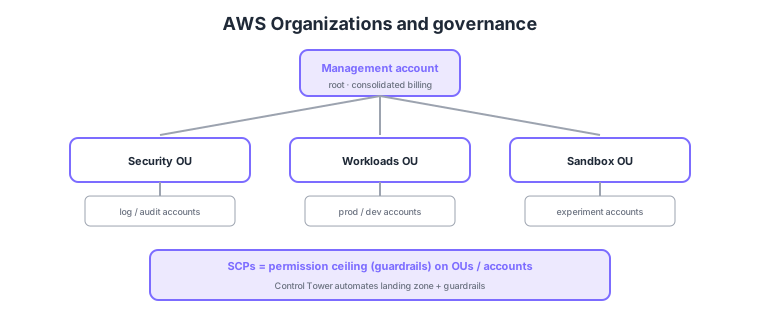
- AWS Organizations: centrally manage accounts in a root → OU → account hierarchy.
- SCP: defines the permission ceiling (guardrail) for OUs/accounts; it restricts rather than grants.
- Consolidated billing: aggregates billing across the org, sharing volume discounts and RIs/Savings Plans.
- Control Tower: automates setup and guardrails for a multi-account landing zone.
Common on SAP-C02: an SCP is a permission ceiling, not a grant (an action needs both IAM allow AND SCP allow), org-wide billing aggregation = consolidated billing, landing-zone automation = Control Tower. Note SCPs do not affect the management account’s root user.
SCPs do not apply to the management account itself. A common pattern is to isolate critical controls in dedicated OUs (e.g., Security/Infrastructure).
Professional multi-account design builds on AWS Organizations, grouping purpose-specific accounts into OUs (e.g., Security OU = log archive/audit, Infrastructure OU = shared networking, Workloads OU = prod/dev, Sandbox OU). Account separation localizes blast radius and gives billing/permission boundaries and dedicated service quotas. An SCP is a permission ceiling (guardrail); effective permissions are IAM allow ∩ SCP allow (explicit DENY always wins), combining inherited FullAWSAccess with explicit Deny for region/service limits. Control Tower auto-builds a landing zone (multiple OUs, centralized logging, SSO) and applies controls (formerly guardrails) as preventive (SCP)/detective (Config rules)/proactive (CloudFormation Hooks), provisioning standardized accounts via Account Factory (or AFT). Cross-account governance uses a Config aggregator, an organization CloudTrail trail, and delegated administrators (centralize GuardDuty/Security Hub in the Security account). Consolidated billing shares RIs/Savings Plans and volume discounts org-wide while cost allocation tags and AWS Budgets give per-account visibility.
| Mechanism | Role | Effect |
|---|---|---|
| SCP | Permission ceiling for OUs/accounts | Both with IAM; DENY wins |
| IAM policy | Grant permissions to principals | Actually grants |
| Control Tower | Landing zone/controls automation | Preventive/detective/proactive |
| Consolidated billing | Aggregate billing, share discounts | Org-wide optimization |
Scenario: across all accounts, forbid non-approved regions and root-user access-key creation. → Attach Deny-based SCPs to the root/relevant OUs (Deny all actions in non-approved regions; Deny iam:CreateAccessKey for root). Provision new accounts with the same guardrails via Control Tower Account Factory, and detect drift with Config and Security Hub.
FAQ: Q. Can an SCP “grant” permissions? → A. No—an SCP only sets a ceiling; IAM grants. An action needs both to allow, and DENY always wins. Q. Centralize org-wide threat detection? → A. Aggregate GuardDuty/Security Hub under a delegated administrator (Security account), enabled org-wide.
Trap: “assigning an SCP grants users permissions” is wrong—an SCP is a ceiling; IAM grants (need both; DENY wins). Also “SCPs apply to the management account too” is wrong—they don’t, so put critical controls on member accounts under dedicated OUs.
1.1.2Section summary
- Organizations = hierarchical governance root → OU → account
- SCP = permission ceiling / billing = consolidated / automation = Control Tower
Sign in to track progress — Log in.
Quick check
(just a quick review)Q1. You must impose a guardrail so accounts under a given OU can never use regions other than allowed ones. What do you use?
Q2. Which statement about SCPs is correct?
Q3. Which managed capability quickly provisions many new accounts with standardized guardrails?
Keep track of your progress
The full study guide is free to read. Sign up free to practice with the question bank, track what you have read, review your mistakes, and highlight passages.