

What's changed: Initial version (topic S1)
1.2General Knowledge of Relational Databases
Organize the basic concepts of the relational data model (tables, rows, columns, primary keys, foreign keys) and the role a DBMS plays. Cover general knowledge of SQL, and its three-way classification by purpose: DDL (data definition language), DML (data manipulation language), and DCL (data control language). Also cover the idea of normalization in database design.
The previous section covered PostgreSQL as software and as a project. This section focuses on the relational database concept that PostgreSQL implements. Before Chapter 3 introduces individual SQL statements (SELECT, CREATE TABLE, and so on), understanding the basic data-model concepts and the three-way classification of SQL will make the rest of the material much easier to follow.
1.2.1The relational data model and the role of a DBMS
- The relational data model represents data as a set of tables (relations). A table is a collection of rows (records/tuples), and each row consists of values for a set of columns (attributes).
- A primary key is a column (or set of columns) that uniquely identifies each row in a table. A foreign key is a column in one table that references another table's primary key, expressing a relationship between tables.
- A DBMS (database management system) is the software foundation responsible for persisting data and making retrieval efficient, plus concurrency control for multiple users, recovery from failures, guaranteeing transaction consistency, and managing access privileges.
1.2.2General SQL knowledge and its three-way classification (DDL/DML/DCL)
- SQL (Structured Query Language) is a standardized language for operating on relational databases. It has a common syntax not tied to a specific vendor, and PostgreSQL is known for its high conformance to standard SQL.
- DDL (Data Definition Language) defines the structure (schema) of tables, views, indexes, and the like. Representative examples:
CREATE,ALTER,DROP. - DML (Data Manipulation Language) operates on the data itself stored in tables. Representative examples:
SELECT(query),INSERT(add),UPDATE(modify),DELETE(remove). - DCL (Data Control Language) controls access privileges on database objects. Representative examples:
GRANT(grant a privilege) andREVOKE(revoke a privilege). Some classifications also place transaction control statements likeCOMMIT/ROLLBACKunder DCL.
1.2.3Database design and normalization
- Database design is the work of deciding which columns belong in which tables and how tables relate to each other, based on the data a business needs to handle. The quality of this design has a major long-term effect on data integrity, maintainability, and performance.
- Normalization is a design technique that reorganizes data crammed into one table into multiple tables, aiming to reduce redundancy and prevent update inconsistencies. It proceeds according to a series of staged criteria (normal forms).
- Normalization proceeds through staged normal forms: first normal form (1NF) removes repeating groups so each column holds a single value; second normal form (2NF) separates out columns that depend on only part of a composite primary key (partial functional dependency); third normal form (3NF) separates out columns that depend on non-key columns (transitive functional dependency). In practice, organizing up to 3NF is a common target.
- Insufficient normalization tends to store the same information redundantly across multiple rows, making it easy for an update to miss some rows—an update anomaly. Normalization sorts out this redundancy and these anomalies, re-expressing relationships with foreign keys instead.
The most-tested item: SQL's three-way classification and its representative commands—define structure = DDL (CREATE/ALTER/DROP), manipulate data = DML (SELECT/INSERT/UPDATE/DELETE), control privileges = DCL (GRANT/REVOKE). Also a standard contrast: the goal of normalization is reducing redundancy and preventing update anomalies, not primarily improving query speed by itself.
Walk through designing a fictional student-management system to touch every concept in this section. Suppose the person in charge first considers a single "students" table that stores name and contact info plus the enrolled course name directly as a column. Once a student takes multiple courses, that student's name and contact info get duplicated once per course, and an address change can easily miss some rows—an update anomaly. This is where normalization comes in: split the design into a "students" table and a "courses" table, add an "enrollments" table to represent the relationship between them, and have each table's primary key referenced as a foreign key, eliminating the duplication of names and course titles. Once the table structure is settled, first use DDL's CREATE TABLE to create the three tables and define the necessary constraints (primary keys, foreign keys). Next, use DML's INSERT to load real data; day to day, SELECT queries enrollment status, and an address change only requires an UPDATE on a single row in the "students" table (thanks to normalization, the update stays in one place). Finally, grant office staff read-only access to the students table with DCL's GRANT SELECT, restricting update privileges to administrators only. Behind this whole flow, the DBMS (PostgreSQL, in this case) is quietly handling concurrency control and guaranteeing transaction consistency.
| Category | Purpose | Representative commands |
|---|---|---|
| DDL | Defining structure (schema) | CREATE / ALTER / DROP |
| DML | Manipulating the data itself | SELECT / INSERT / UPDATE / DELETE |
| DCL | Controlling access privileges | GRANT / REVOKE |
Trap: "CREATE TABLE is classified under Data Manipulation Language (DML)" is wrong—CREATE defines structure and is classified as DDL. Also wrong: "the main goal of normalization is to speed up query execution"—normalization's main goal is reducing data redundancy and preventing update anomalies; splitting tables adds joins and can sometimes make queries slower than a simpler denormalized structure.
1.2.4Section summary
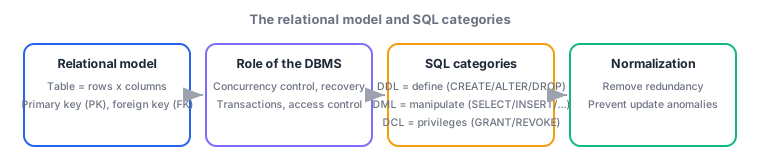
- The relational data model = tables (rows × columns) with relationships expressed via primary/foreign keys. A DBMS underpins concurrency, recovery, and transactions
- SQL's three categories: DDL (CREATE/ALTER/DROP — define structure) / DML (SELECT/INSERT/UPDATE/DELETE — manipulate data) / DCL (GRANT/REVOKE — control privileges)
- The goal of normalization is reducing redundancy and preventing update anomalies (not query speed by itself)
Sign in to track progress — Log in.
Quick check
(just a quick review)Q1. A "students" table stores the course name as a direct column, so a student taking multiple courses ends up with the name duplicated once per course, and an address change sometimes misses some rows. What is the appropriate fix?
Q2. Which correctly classifies the three SQL statements CREATE TABLE, GRANT, and SELECT into DDL, DML, and DCL?
Q3. What is the most appropriate description of the main goal of normalization in database design?
Keep track of your progress
The full study guide is free to read. Sign up free to practice with the question bank, track what you have read, review your mistakes, and highlight passages.