

What's changed: Created Generative AI Leader Chapter 1 (Domain 1 "Fundamentals of generative AI": AI/ML/gen AI relationship = nesting/learning types/data types/modalities-multimodal; LLMs and foundation models = how LLMs work/tokens/prompts/pretraining-fine-tuning/embeddings; limitations and risks = hallucination/bias/knowledge cutoff/privacy).
1.1How AI, machine learning, and generative AI relate
Understand the nesting of artificial intelligence (AI), machine learning (ML), deep learning, and generative AI; the learning types (supervised, unsupervised, reinforcement); structured vs unstructured data; and modalities such as text, image, audio, and multimodal—from a business perspective.
Generative AI is AI that creates new content—text, images, audio, code, and more. Generative AI Leader is an entry-level credential testing the perspective of a leader who can judge "how to apply generative AI to business, and what value and risks it brings," rather than implementation. First, place generative AI within AI as a whole.
1.1.1Generative AI within AI
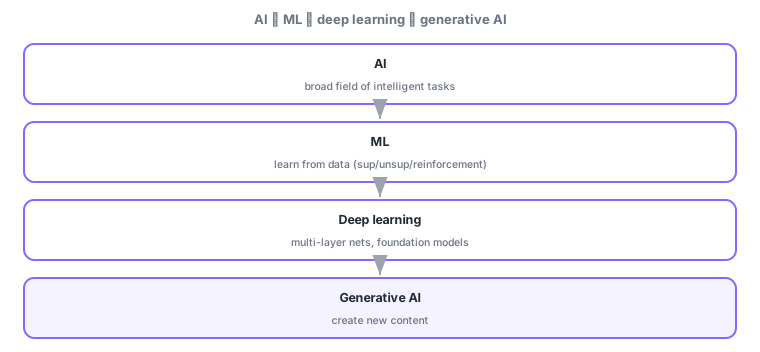
Artificial intelligence (AI) is the broad field of having computers perform intelligent tasks; within it is machine learning (ML) that learns from data, within that deep learning using multi-layer neural networks, and generative AI. Generative AI builds on deep learning (especially foundation models) to create new content in response to input (a prompt). Whereas traditional AI/ML mainly "classifies, predicts, or detects," generative AI is distinct in that it "generates."
1.1.2Types of learning
| Type | Training data | Typical task |
|---|---|---|
| Supervised | Labeled | Classification/prediction (e.g., demand forecast) |
| Unsupervised | Unlabeled | Clustering (e.g., segmentation) |
| Reinforcement | Reward via trial and error | Policy optimization (e.g., control, recommendation) |
Machine learning includes supervised learning (classify/predict with labels), unsupervised learning (group without labels), and reinforcement learning (learn a policy by trial and error guided by rewards). Foundation models such as large language models are first pretrained on vast data in a largely self-supervised way, then tuned toward desirable behavior with techniques like reinforcement learning from human feedback (RLHF). In all cases, the quality and quantity of data largely determine results.
1.1.3Data types and modalities
Data is either structured data with a fixed format (like tables) or unstructured data without a fixed format (images, video, audio, free text). Generative AI is especially good with unstructured data. The type of input/output is called a modality—text, image, audio, video, etc. A model that can understand and generate across multiple modalities is multimodal; Google Gemini is a prime example (e.g., looking at an image and writing a caption).
Common: trait → term. E.g., "create new content" = generative AI; "classify/predict/detect" = traditional AI/ML; "learn from labels" = supervised; "trial and error via rewards" = reinforcement; "handles both images and text" = multimodal; "broadly reusable pretrained model" = foundation model.
Watch the mix-ups: (1) the nesting AI ⊃ ML ⊃ deep learning ⊃ generative AI. (2) Generative AI mainly "generates"; traditional AI/ML mainly "classifies/predicts." (3) Distinguish modality (type of input/output) from multimodal (supports multiple modalities).
1.1.4Section summary
- AI ⊃ ML ⊃ deep learning ⊃ generative AI; generative AI "generates" new content
- Learning = supervised (labels) / unsupervised (grouping) / reinforcement (rewards); data quality and quantity matter
- Structured/unstructured data, modalities (text/image/audio), multimodal (Gemini)
Sign in to track progress — Log in.
Quick check
(just a quick review)Q1. Compared with traditional AI/ML, what is the most fundamental difference of generative AI?
Q2. Which correctly describes the relationship of AI, ML, deep learning, and generative AI?
Q3. What is the property of a model that can understand and generate across images, text, and audio?
Q4. Which learning type trains on labeled data to classify or predict?
Q5. Which learning type uses rewards and trial-and-error to learn desirable behavior?
Q6. Which data has no fixed format, like images, video, audio, and free-form text?
Keep track of your progress
The full study guide is free to read. Sign up free to practice with the question bank, track what you have read, review your mistakes, and highlight passages.