

What's changed: Deepened DP-900 Chapter 1 to the AZ-900 baseline (three data kinds + store/role tables, OLTP/OLAP + ACID/data warehouse/ETL-ELT, scenarios, FAQ, traps, more quizzes)
1.1Types of Data and Data Roles
Understand the three kinds of data (structured, semi-structured, unstructured), the stores suited to each, and the main data roles (database administrator, data engineer, data analyst). The starting point for DP-900.
How data is stored and processed depends on its "shape." DP-900 starts by classifying data as structured, semi-structured, or unstructured. This classification is the basis for choosing the relational/non-relational stores and services in later chapters. We also lay out the human roles—who operates, who builds the flow, and who analyzes.
1.1.1The three kinds of data
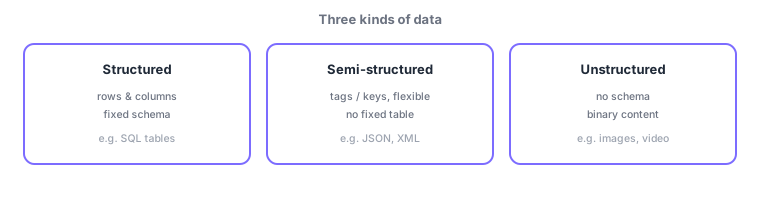
Structured data follows a predefined fixed schema of rows and columns. Each column has a type (number, string, date), and rows line up strictly like a spreadsheet. The classic example is a relational database table queried with SQL. A fixed schema makes search, aggregation, and joins fast and precise, but changing the structure requires a design change.
Semi-structured data has structure via tags or keys but is not bound to a fixed schema, so it is flexible. Classic examples are JSON, XML, and key-value pairs. Because each item can have different fields, it is resilient to change and suits web APIs and document-oriented storage. The hallmark is "structured but not fixed."
Unstructured data has no fixed schema in its content—images, video, audio, PDFs, and text documents. It cannot be expressed in rows and columns, so it is stored as files or objects and, when needed, mined with AI (computer vision or NLP). Most data in the world is unstructured.
| Kind | Structure | Examples | Suited store |
|---|---|---|---|
| Structured | Fixed rows/columns | SQL tables (sales, customers) | Relational DB (Azure SQL) |
| Semi-structured | Tags/keys, flexible | JSON, XML | NoSQL (Cosmos DB) |
| Unstructured | No schema | Images, video, docs | Object storage (Blob) |
1.1.2Roles involved with data
Data work is divided among several distinct roles. Remembering each by "what it is responsible for" helps with the exam’s "task → role" questions.
- Database administrator (DBA): manages database availability, performance, security, and backup/restore—responsible for stable day-to-day operations.
- Data engineer: builds ingestion, transformation, integration, and pipelines, preparing data for analysis.
- Data analyst: analyzes and visualizes prepared data, supporting decisions via reports and dashboards.
| Role | Main responsibility | Typical tools |
|---|---|---|
| DBA | Operations, performance, security, backup | SSMS, etc. |
| Data engineer | Ingestion, transformation, pipelines | Azure Data Factory, Synapse |
| Data analyst | Analysis, visualization, reporting | Power BI |
Scenario: a retail chain’s data. Store POS sales lines (structured) go to Azure SQL, website clickstream (JSON = semi-structured) to Cosmos DB, and product photos/receipt images (unstructured) to Blob storage. A data engineer consolidates them in a pipeline, a data analyst builds a sales dashboard in Power BI, and a DBA manages each database’s performance and backups. Store and owner differ by kind.
Watch the mix-ups: (1) semi-structured (JSON/XML = structured via tags/keys) vs unstructured (images/video = no structure)—JSON "has structure," so it is semi-structured. (2) Structured is not always relational, but the exam usually maps "fixed rows/columns = structured = SQL." (3) Tell roles apart by the task (pipelines = engineer / visualization = analyst / operations & backup = DBA).
Q. Is CSV structured or semi-structured? With consistent rows/columns and types it is treated as structured (tabular). Q. Can you search unstructured data? Not directly, but AI can extract text/objects, or metadata (date, tags) can make it searchable. Q. What about data scientists? DP-900 focuses on DBA/engineer/analyst, but data scientists also participate, building machine-learning models.
Common mappings: example → data kind and task → role. JSON/XML = semi-structured, images/video/docs = unstructured, SQL tables = structured. Pipelines = data engineer, visualization = data analyst, backup/performance = DBA.
1.1.3Section summary
- Data = structured (rows/columns, SQL) / semi-structured (JSON, tags/keys) / unstructured (images, no schema)
- Each kind has a suited store: structured → relational, semi-structured → NoSQL, unstructured → object storage
- Roles = DBA (operations/backup) / data engineer (pipelines) / data analyst (analysis/visualization)
Sign in to track progress — Log in.
Quick check
(just a quick review)Q1. Data like JSON or XML—structured via tags/keys but flexible—is which kind?
Q2. Data like images or video, with no fixed schema, is which kind?
Q3. Which role builds ingestion and transformation pipelines?
Q4. Data with a fixed schema of rows/columns, queried with SQL, is which kind?
Q5. Which role builds reports/dashboards in Power BI to support decisions?
Q6. Which is the most appropriate store for unstructured data such as product photos?
Keep track of your progress
The full study guide is free to read. Sign up free to practice with the question bank, track what you have read, review your mistakes, and highlight passages.