

What's changed: In-scope coverage: added purpose-built stores/storage (DocumentDB/Keyspaces/MemoryDB/S3 Tables/EFS/CloudFront/Backup)
2.1Designing an S3 Data Lake
Understand an S3-centric data lake (raw/cleaned/curated layers), partitioning and columnar formats, and cost optimization via storage classes and lifecycle. The starting point for "Data Store Management" in DEA-C01.
An S3 data lake stores diverse data cheaply at scale. Good layering, partitioning, and formats make analysis faster and cheaper.
2.1.1Layers and formats
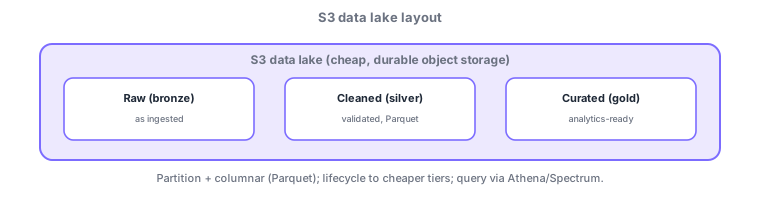
- Layers: improve quality in stages—raw → cleaned → curated.
- Partitioning: split by date/region folders to reduce scanned data per query.
- Columnar formats: Parquet/ORC improve compression and analytics performance.
- Storage classes/lifecycle: move data to cheaper classes by access frequency to cut cost.
Common on DEA: reduce scanned data and cost = partition + Parquet, raw/cleaned/curated layering, move aging data to cheaper classes = lifecycle. S3 is the heart of the data lake.
Design an S3 data lake by "layers × layout × lifecycle." Layers raise quality through raw (bronze) → cleaned (silver) → curated (gold), separated by prefix. The core of layout is columnar (Parquet/ORC) conversion and partitioning (by commonly filtered columns like date/region), slashing downstream Athena scanned data (= cost). Many tiny files hurt performance, so compact them, and use partition projection in Athena to skip metadata management. If you need updates/deletes/time-travel, use table formats like Apache Iceberg/Hudi/Delta; centralize permissions with Lake Formation (column/row level). Lifecycle auto-transitions S3 Standard → Standard-IA → Glacier by access frequency (use Intelligent-Tiering when unsure). Encryption at rest (SSE-KMS), versioning, and Object Lock against accidental deletion are basics. S3’s eleven-nines durability makes it the heart of the data lake.
| Design axis | Lever |
|---|---|
| Quality stages | Raw → cleaned → curated |
| Reduce scan/cost | Parquet + partition + compaction |
| Update/delete/time-travel | Iceberg/Hudi/Delta |
| Storage cost | Lifecycle / Intelligent-Tiering |
Scenario: raw JSON keeps growing; analysis is slow and costly. Keep it in raw (bronze), then convert to Parquet with Glue ETL and partition by date into the cleaned (silver) layer. Athena queries silver/gold, slashing scanned data. Move old raw data to Glacier via lifecycle and protect against deletion with versioning + Object Lock.
Q. Reduce scanned data? Parquet + partitioning. Q. Layering? Raw → cleaned → curated. Q. Cost of old data? Lifecycle (Glacier, etc.). Q. Need updates/deletes? Iceberg/Hudi/Delta. Q. Centralize permissions? Lake Formation.
Watch the mix-ups: (1) Leaving row-based CSV inflates Athena scanned data (cost)—Parquet + partitioning is the norm. (2) Many tiny files hurt performance/cost (compact). (3) Plain S3 (Parquet) is poor at row-level updates—use a table format like Iceberg if you need them. (4) Glacier retrieval has latency/cost—don’t put frequently accessed data there.
Lake Formation centrally manages data-lake permissions at column/row level, easing governance (covered in Chapter 4).
2.1.2Section summary
- Layers (raw/cleaned/curated) + partitioning + Parquet
- Optimize storage cost with lifecycle
Sign in to track progress — Log in.
Quick check
(just a quick review)Q1. What most effectively reduces scanned data and cost for queries in an S3 data lake?
Q2. Which is a common layering for quality stages in a data lake?
Q3. You want to auto-reduce storage cost for aging, less-accessed data. What do you use?
Keep track of your progress
The full study guide is free to read. Sign up free to practice with the question bank, track what you have read, review your mistakes, and highlight passages.