

What's changed: Created Cloud Digital Leader Chapter 6 (Domain 6 "Operations": financial governance and cost management = resource hierarchy (org/folder/project)/billing account/budgets and alerts/CUD-SUD/cost optimization; operational reliability and sustainability = SRE/availability-scalability/Cloud Monitoring-Cloud Logging/Carbon Footprint).
6.1Financial governance and managing cloud costs
Understand the resource hierarchy (organization, folders, projects) and billing accounts, cost visibility and control via budgets and alerts, discounts such as committed use discounts (CUD) and sustained use discounts (SUD), and the basics of cost optimization.
Because cloud is pay-as-you-go, costs rise and fall with usage. That makes financial governance (the FinOps mindset)—visualizing who uses how much and curbing waste—important. First, understand the units for managing cost: the resource hierarchy and billing.
6.1.1Resource hierarchy and billing accounts
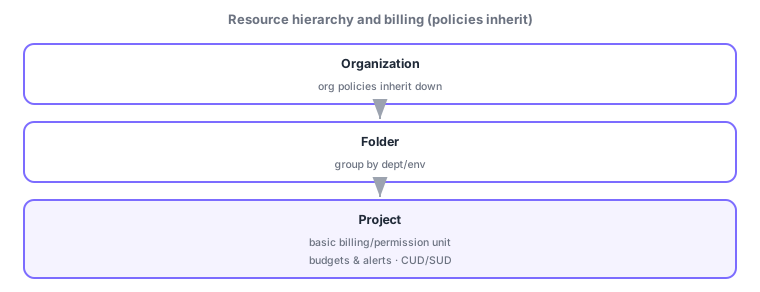
Google Cloud resources are organized as Organization → Folder → Project → resources. A Project is the basic unit of billing, permissions, and resources, and costs are tracked per project. Costs are paid via a Billing Account linked to projects. Because IAM policies and organization policies are inherited down this hierarchy, you can apply consistent governance organization-wide. The basics: "separate cost and permissions per project."
6.1.2Budgets, alerts, and discounts
To prevent runaway costs, set budgets and alerts to notify when a threshold (e.g., 50%/90% of budget) is reached (note: this does not automatically stop spending). Analyze cost breakdowns via billing reports or exporting billing data to BigQuery. Discounts include committed use discounts (CUD)—commit to a period of usage for lower prices—and sustained use discounts (SUD)—automatic discounts the longer you run.
| Mechanism | What it is | When it fits |
|---|---|---|
| Committed use discount (CUD) | Commit to 1–3 years for a discount | Steady, ongoing usage |
| Sustained use discount (SUD) | Automatic discount the longer you run | Long-running within a month |
| Spot VM | Deep discount, may be preempted | Interruption-tolerant batch |
Common: requirement → term. E.g., "basic unit of billing/permissions/resources" = Project; "governance via Organization→Folder→Project inheritance" = resource hierarchy/organization policy; "notify at thresholds (not auto-stop)" = budgets and alerts; "discount for a 1–3 year commitment" = CUD; "automatic discount for running longer" = SUD; "cheap interruption-tolerant batch" = Spot VM.
Watch the mix-ups: (1) budget alerts notify; they do not auto-stop spending. (2) CUD (discount for an upfront commitment) vs SUD (automatic discount for sustained use) differ. (3) The basic cost unit is the Project, with permissions/policies inherited down the hierarchy.
6.1.3Section summary
- Resource hierarchy = Organization → Folder → Project; the Project is the basic billing/permission unit (policies inherit)
- Budgets and alerts notify at thresholds (no auto-stop); analyze billing via reports/BigQuery
- Discounts = CUD (commitment) / SUD (automatic for sustained use) / Spot VM (deep discount, preemptible)
Sign in to track progress — Log in.
Quick check
(just a quick review)Q1. What is the basic unit that groups billing, permissions, and resources in Google Cloud?
Q2. Which correctly describes how budget alerts behave?
Q3. Which mechanism gives a discount in exchange for committing to 1–3 years of usage upfront?
Q4. Which discount applies automatically the longer you run a resource, without a special contract?
Q5. What is inherited down the resource hierarchy to apply consistent governance organization-wide?
Q6. Which is the most appropriate practice for cloud cost optimization?
Keep track of your progress
The full study guide is free to read. Sign up free to practice with the question bank, track what you have read, review your mistakes, and highlight passages.