

What's changed: Created Cloud Digital Leader Chapter 3 (Domain 3 "AI": AI/ML fundamentals = AI/ML/generative AI relationship, supervised/unsupervised, training data, responsible AI; Google Cloud AI/ML solutions = Agent Platform/Gemini/Vision/Speech-to-Text/Natural Language/Translation/BigQuery ML/Document AI/Conversational Agents).
3.1AI and machine learning fundamentals
Understand the relationship between artificial intelligence (AI), machine learning (ML), and generative AI; the difference between supervised and unsupervised learning; how the quality and quantity of training data drive results; and the importance of responsible AI such as fairness, accountability, and privacy—from a business perspective.
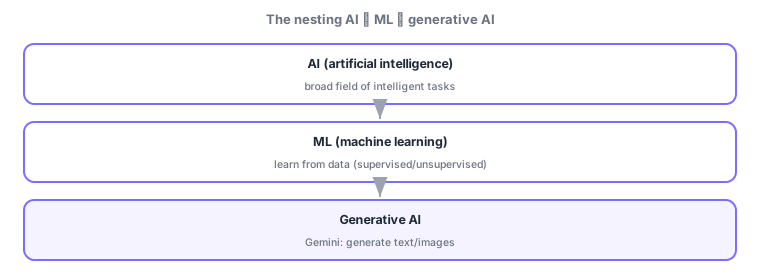
Artificial intelligence (AI) is the broad field of having computers perform intelligent tasks. Its core method is machine learning (ML), which learns patterns from large amounts of data to predict and classify. Recently, generative AI that creates new text, images, and code has spread, with Gemini at the center on Google Cloud. For Cloud Digital Leader, the key is understanding which business problems these can solve.
3.1.1Supervised vs unsupervised learning
| Type | Training data | Typical task |
|---|---|---|
| Supervised learning | Labeled data | Classification/regression (e.g., fraud detection, demand forecast) |
| Unsupervised learning | Unlabeled data | Clustering (e.g., customer segmentation) |
Supervised learning trains on "labeled" (answer) data to classify or predict (e.g., detecting fraud from past transactions). Unsupervised learning finds hidden structure or groups in "unlabeled" data (e.g., segmenting similar customers). For both, the quality and quantity of training data largely determine results. Training on biased data yields biased outcomes.
3.1.2Responsible AI
AI is powerful, but misuse can lead to discrimination or privacy violations. Responsible AI designs and operates AI under principles such as fairness (avoid bias), transparency/accountability (explain and own decisions), privacy and security, and human-centeredness (keep human oversight). Google publishes AI principles and delivers services accordingly. Business leaders must judge "not just accuracy, but also fairness, accountability, and privacy."
Common: example → term. E.g., "classify/predict with labels" = supervised learning; "group without labels" = unsupervised learning; "generate new text or images" = generative AI (Gemini); "biased data → biased results" = bias (responsible AI); "AI that preserves fairness, accountability, privacy" = responsible AI.
Watch the mix-ups: (1) the nesting AI ⊃ ML ⊃ generative AI (generative AI is a kind of ML). (2) supervised (labeled) / unsupervised (unlabeled). (3) AI quality depends on not just accuracy but training-data quality and fairness. (4) Responsible AI is not "don’t use it" but "use it correctly under principles."
3.1.3Section summary
- AI ⊃ ML ⊃ generative AI; generative AI (Gemini) creates new text, images, etc.
- Supervised (labeled = classify/predict) / unsupervised (unlabeled = clustering); data quality and quantity drive results
- Responsible AI = fairness, transparency/accountability, privacy, human-centered; do not judge on accuracy alone
Sign in to track progress — Log in.
Quick check
(just a quick review)Q1. Which type of machine learning trains on labeled data to classify or predict?
Q2. Which learning finds similar groups (e.g., customer segments) from unlabeled data?
Q3. What do we call AI that creates new text, images, or code?
Q4. Which factor most strongly determines machine learning results?
Q5. Which approach designs and operates AI under principles like fairness, accountability, privacy, and human-centeredness?
Q6. Which correctly describes the relationship of AI, ML, and generative AI?
Keep track of your progress
The full study guide is free to read. Sign up free to practice with the question bank, track what you have read, review your mistakes, and highlight passages.