

What's changed: In-scope coverage: added other-category overview (API Gateway/Global Accelerator/PrivateLink/Transit Gateway/Client VPN/EventBridge/SNS/SQS/Step Functions/SES/Amplify/AppSync/IoT Core/WorkSpaces/AppStream/DocumentDB/SageMaker AI/CLI/CodeBuild/CodePipeline/X-Ray) and migration & transfer (Migration Hub/Discovery/Evaluator/MGN/DMS/SCT/Snow Family) to §4.3
4.2Database Services
Understand AWS managed databases—relational Amazon RDS (including Aurora) and NoSQL key-value Amazon DynamoDB—and when to use each.
Data is broadly relational (tables, fixed schema, SQL) or NoSQL (flexible schema), and AWS offers both as managed services (AWS handles patching, backups, availability). The benefit is far less effort than running a DB server yourself. The mainstays are Amazon RDS (relational) and Amazon DynamoDB (NoSQL).
4.2.1RDS and DynamoDB
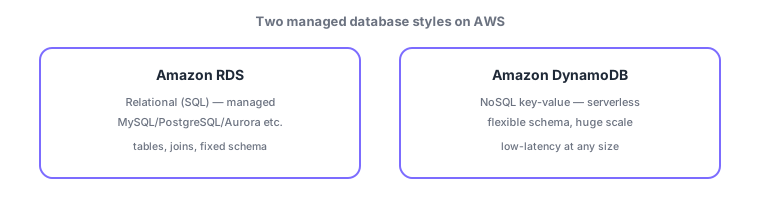
- Amazon RDS: a managed relational (SQL) DB supporting MySQL, PostgreSQL, MariaDB, Oracle, SQL Server; Amazon Aurora is AWS’s high-performance MySQL/PostgreSQL-compatible engine. Good for tables, joins, fixed schema. Multi-AZ for HA, read replicas to scale reads.
- Amazon DynamoDB: NoSQL key-value/document, serverless, with a flexible schema and single-digit-millisecond latency at huge scale; no capacity planning or server management.
| Aspect | Amazon RDS (incl. Aurora) | Amazon DynamoDB |
|---|---|---|
| Type | Relational (SQL) | NoSQL key-value/document |
| Schema | Fixed (tables, joins) | Flexible |
| Operations | Managed (you pick instances) | Serverless |
| Good for | Business apps, strong consistency | Huge scale, low latency, variable schema |
4.2.2Peripheral knowledge: purpose-built databases
AWS also offers purpose-built managed databases (no deep dive needed—just names/uses): Amazon ElastiCache = fast in-memory cache (Redis/Memcached), Amazon Redshift = data warehouse for large-scale analytics, Amazon Aurora = high-performance relational, plus graph (Neptune), time-series, and more. AWS’s philosophy is "the right database for the job."
Scenario: data design for e-commerce. Put consistency-critical business data (orders, inventory) in RDS (Aurora), very large-scale low-latency data (sessions, carts) in DynamoDB, speed up hot-product reads with ElastiCache, and run sales analytics on Redshift. Rather than forcing one store, choose the best DB per use.
Watch the mix-ups: (1) RDS (relational, SQL, instance-based) vs DynamoDB (NoSQL, serverless). (2) Aurora is a high-performance RDS engine (not a separate category). (3) ElastiCache = cache / Redshift = analytics (DWH)—different roles. (4) "managed" ≠ "serverless"—RDS is managed but you still pick instances.
Common points: RDS = managed relational (SQL), Aurora is AWS’s engine / DynamoDB = serverless NoSQL (huge scale, low latency) / ElastiCache = in-memory cache / Redshift = data warehouse (analytics). Also note "managed = AWS handles operations."
4.2.3Section summary
- RDS = relational (SQL), managed (Aurora is the high-performance engine; Multi-AZ/read replicas)
- DynamoDB = NoSQL, serverless (huge scale, low latency)
- Purpose-built: ElastiCache (cache) / Redshift (analytics DWH)—"the right database for the job"
Sign in to track progress — Log in.
Quick check
(just a quick review)Q1. Which AWS service offers managed relational (SQL) databases?
Q2. Which is a serverless NoSQL key-value database with low latency at scale?
Q3. What is a main benefit of a "managed database"?
Q4. Which AWS service best fits large-scale data analytics (data warehouse)?
Q5. Which correctly describes Amazon Aurora?
Keep track of your progress
The full study guide is free to read. Sign up free to practice with the question bank, track what you have read, review your mistakes, and highlight passages.