

What's changed: Initial version
6.3Controller APIs and interpreting REST responses
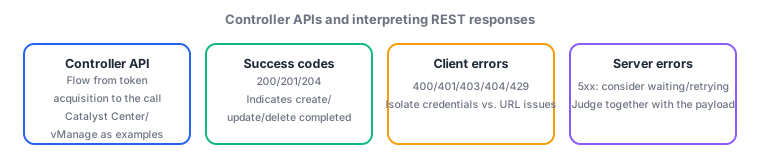
Covers Catalyst Center's Intent API and SD-WAN Manager (vManage)'s REST API as a flow from token acquisition to the actual call, then teaches deciding what to do next (retry, fix credentials, fix the URL, or wait) from the returned status code—200/201/204, 400/401/403/404/429, and 5xx—together with the payload.
What burns the most time in controller-API automation is misreading the returned code and trying to fix the wrong thing. Rewriting the URL over and over when a 401 came back, or retrying instantly on a 429 and jamming things further—both stem from failing to read where the code says responsibility lies. Broadly, status codes signal a division of responsibility: 2xx = success, 4xx = the caller's (client's) problem, 5xx = the server's problem. Using the real controllers Catalyst Center and SD-WAN Manager, this section follows the full arc of obtaining an auth token -> making the call -> interpreting the response -> choosing the next action.
6.3.1The shape of a controller API call
- Catalyst Center (formerly DNA Center) is an on-prem controller governing the enterprise access network, exposing the Intent API. A call first obtains a token by sending credentials with Basic auth to
POST /dna/system/api/v1/auth/token, then carries that token in theX-Auth-Tokenheader to intent-based endpoints such as/dna/intent/api/v1/network-device. Tokens expire, and calls after expiry return401. - SD-WAN Manager (vManage) is the management controller for the WAN overlay, handling device inventory, templates, policies, and statistics over REST. After authenticating you call endpoints such as
/dataservice/device, maintaining a session (and a CSRF token) for operations. On both controllers the pattern is the same: authentication is a separate request, and subsequent calls present credentials in a header. - The HTTP method expresses the kind of operation:
GET= read (safe, changes nothing) /POST= create (spawns a new resource or job) /PUT= replace (fields you omit may be cleared) /PATCH= partial update /DELETE= remove. On controllers aPOSToften does not complete immediately but returns a "task ID" for asynchronous processing, in which case you mustGETthe task-status endpoint to confirm completion.
6.3.2Where the status code places responsibility
- 2xx = success.
200 OKmeans the request succeeded with a body (payload) (typical ofGET).201 Createdmeans a new resource was created (typical ofPOST, with the location given in aLocationheader or the body).204 No Contentmeans success with no body to return (typical ofDELETEand some updates)—reading a204as failure and re-running it risks double execution. - 4xx = the caller's problem, so retrying the identical request will not fix it.
400 Bad Requestmeans the request's form or content is invalid (JSON syntax error, missing required field, type mismatch) -> fix the payload.401 Unauthorizedmeans not authenticated (no token presented, expired, or wrong credentials) -> re-obtain the token.403 Forbiddenmeans authentication succeeded but authorization is lacking -> review the account's role/permissions (re-fetching a token yields the same result). 404 Not Foundmeans the specified resource (URL) does not exist -> check the endpoint path and resource ID spelling (unlike401, this is not a credentials problem).429 Too Many Requestsmeans you hit the rate limit -> do not retry immediately; honor theRetry-Afterheader if present and resend with exponential backoff (lowering concurrency or switching to a bulk fetch also helps).- 5xx = the server's problem (
500 Internal Server Error,502 Bad Gateway,503 Service Unavailable), and the request itself is likely correct. Rewriting the payload or token is therefore beside the point; the right move is retry with backoff plus checking the controller's logs and health. A503usually indicates transient overload or maintenance.
Memorize status codes by splitting them three ways by "whose fault it is": 2xx = success (200 with a body, 201 created, 204 success with no body); 4xx = the caller (400 fix the payload, 401 re-obtain the token, 403 review permissions, 404 fix the URL, 429 wait and back off); 5xx = the server (retry with backoff without changing the content). ENCOR asks "this code came back—what do you do next?", so learn them as code -> remedy pairs.
Suppose you operate a script that pulls the full device inventory from Catalyst Center and then fetches interface details per device. One morning the run log records three responses in sequence: the inventory call GET /dna/intent/api/v1/network-device returned 401 Unauthorized; a re-run of the same call returned 200 OK with a list of 500 devices; and partway through the per-device interface loop, 429 Too Many Requests began repeating. The common mistake here is seeing the 401, concluding "the account lacks permissions," and asking an administrator for a role upgrade. But 401 is an authentication failure (who you are cannot be verified), whereas 403 is what signals insufficient permission (authenticated but not allowed). The log shows the call succeeded with 200 on a mere re-run—so the credentials and role were fine and the correct reading is that the token had simply expired. The durable fix is not a role change but adding logic that tracks token lifetime and, on a 401, automatically re-fetches from /auth/token and retries exactly once. As for the 429, reading it as "the server broke" and retrying immediately and repeatedly is the worst move, since it trips the rate limit further and delays recovery. A 429 is the controller explicitly saying "you are calling too much," so honor the Retry-After header if present and otherwise space calls with exponential backoff (1s, 2s, 4s...). The more structural improvement is to revisit the design of querying 500 devices one at a time, using bulk endpoints or pagination to cut the number of calls. Had a 500 been returned instead, the diagnosis inverts: the request is correct but processing failed on the controller, so touching the payload or token is beside the point—back off and retry while checking controller health and logs. Likewise, if a POST registering a new device returns 202 or a body containing a task ID, it means the work is not finished, and you must not treat it as success until you GET the task-status endpoint and confirm completion. Conversely, when a DELETE returns 204 No Content, treating the empty body as failure and re-running it is dangerous—204 means success with nothing to return, and the deletion has in fact completed. In short, ENCOR asks not for the semantics of the code itself but for the choice of next move: "given this code, is what needs fixing the payload, the credentials, the permissions, the URL, or the call rate—or should nothing be changed and you simply wait?"
| Code | Meaning | Responsibility | Next action |
|---|---|---|---|
| 200 OK | Success with a body (payload) | — | Parse the body and continue |
| 201 Created | A new resource was created | — | Record the location (`Location` header or body ID) |
| 204 No Content | Success with no body to return | — | Treat as success (do not re-run) |
| 400 Bad Request | Malformed form or content (JSON syntax, type, missing field) | Caller | Fix the payload (retrying alone will not help) |
| 401 Unauthorized | Not authenticated (token missing or expired) | Caller | Re-obtain the token and retry once |
| 403 Forbidden | Authenticated but not authorized | Caller | Review the account role/permissions |
| 404 Not Found | The specified resource or URL does not exist | Caller | Verify the path and resource ID |
| 429 Too Many Requests | Rate limit reached | Caller | Honor `Retry-After`, back off exponentially, reduce call volume |
| 5xx (500/502/503) | Server-side failure, overload, or maintenance | Server | Retry with backoff unchanged and check the controller |
Trap: Confusing 401 with 403 is the most common error—401 is authentication (identity unverified: re-obtain the token) and 403 is authorization (identity known but not allowed: review permissions), so requesting a role upgrade for a 401 misses the point. Also wrong: "204 has no body, so it failed"—it is success, and re-running invites double execution. And "429 is a server fault, so retry immediately" is wrong—it is an explicit signal that you are calling too much, and things worsen unless you wait and back off. Conversely, rewriting the payload or token on a 5xx is beside the point.
6.3.3Section summary
- Both Catalyst Center's Intent API and SD-WAN Manager (vManage) share the pattern of authenticating in a separate request and presenting the token/session in a header
- Split codes by where responsibility lies—2xx = success (including
204), 4xx = the caller (400payload,401token,403permissions,404URL,429rate), 5xx = the server - What is asked is not semantics but the next action: re-obtain the token on
401, review permissions on403, honorRetry-Afterwith exponential backoff on429, and retry unchanged with backoff on5xx
Sign in to track progress — Log in.
Quick check
(just a quick review)Q1. A script calling Catalyst Center's Intent API returned `401 Unauthorized`. The same credentials worked fine until a few hours earlier, and a re-run returned `200 OK`. What is the most appropriate durable fix?
Q2. Partway through a loop fetching interface details one device at a time across 500 devices, the controller began returning `429 Too Many Requests`. What is the most appropriate response?
Q3. A `DELETE` sent to a controller API returned `204 No Content` with an empty body. The script is implemented to treat this as a failure and resend the same `DELETE`. How should this implementation be assessed?
Keep track of your progress
The full study guide is free to read. Sign up free to practice with the question bank, track what you have read, review your mistakes, and highlight passages.