

What's changed: Initial version
5.2Testing, CI/CD, and automation tools
Covers the CI/CD pipeline (lint -> test -> deploy) for shipping network changes safely, Cisco Modeling Labs (CML) for trying changes in a virtual lab, pyATS for validating state, and the strengths of Ansible (agentless, idempotent), Terraform (declarative, state management), and Cisco NSO (multi-vendor, service model), framed as the judgment of "what does this pipeline stage protect" and "which tool for this requirement."
Automation also carries the danger of "distributing a wrong configuration faster and wider." That is exactly why you need a mechanism to verify changes mechanically before they reach production (tests and a pipeline). This section organizes what each CI/CD stage protects when shipping network changes safely, the roles of the virtual lab CML and the test framework pyATS, and choosing among Ansible, Terraform, and NSO by "what each is good at"—as a match against requirements, not rote tool comparison.
5.2.1Stages of a CI/CD pipeline
- CI (Continuous Integration) runs an automatic build, check, and test on every commit/Pull Request, catching broken changes early. For networks, a lint (syntax/format check) stage (e.g.,
yamllint) first mechanically confirms "is the syntax even valid?" If it fails here, the change stops before reaching production. - CD (Continuous Delivery/Deployment) is the stage that distributes passing changes to production automatically (or after approval). A typical order is
lint -> test in a virtual lab -> approval -> deploy to production -> post-verification. Each stage is a gate that lets only what passed the previous one through, and which stage failed becomes the clue for isolating the cause.
5.2.2Test tools: CML and pyATS
- Cisco Modeling Labs (CML) is an environment that simulates a virtual network close to real hardware. In the pipeline's "test stage," you build the same topology as production in CML and try changes safely before production (a sandbox). You can validate without physical gear, and breaking it does not affect production.
- pyATS (+Genie) is Cisco's network test-automation framework. It parses
showoutput into structured data and mechanically asserts expected state—"are BGP neighbors Established?", "is the interface up?" It is used to compare before/after state and detect regressions (unexpected degradation).
5.2.3Configuration/orchestration tools
- Ansible is an agentless (no resident software on targets; mainly SSH/API) configuration tool that writes the "desired state" in a YAML playbook and applies it push-style. Many modules are built to be idempotent, and it is widely used to configure/collect from network devices (
ios_config, etc.). It is relatively easy to learn/adopt. - Terraform is a provisioning tool that defines infrastructure declaratively, tracks "what is currently built" in a state file, and applies only the diff. It is strong at the create/destroy lifecycle of cloud resources and infrastructure; its core is diff management (plan/apply) between "desired" and "actual."
- Cisco NSO (Network Services Orchestrator) abstracts a multi-vendor network as a service model and translates/distributes/reconciles a higher-level intent like "provision one L3VPN" into each device's configuration. It is strong at multi-vendor, large-scale service delivery and continuous consistency.
Most-tested: CI/CD = gates of lint -> test in CML -> approval -> production -> post-verification; CML = try changes safely before production in a virtual network; pyATS = structure show output and validate expected state (regression detection); Ansible = agentless/YAML/push/idempotent; Terraform = declarative/state management/provisioning; NSO = multi-vendor service-model orchestration. Choose each tool by its strength.
A team's CI/CD pipeline runs, per Pull Request to Git, in this order: (1) yamllint checks the playbook format -> (2) spin up a production-like topology in CML and apply the change -> (3) pyATS validates "all BGP neighbors Established" and "target IFs up" -> (4) human approval -> (5) apply to production with Ansible -> (6) post-verify production with pyATS. One day a PR fails at stage (3) and stops. The log shows that after applying the change in CML, "one site's BGP neighbor stayed Idle." The key is to read this failure not as a pipeline malfunction but as proof the pipeline did its job: without this validation stage, the misconfiguration would have been distributed to every production site, noticed only after BGP actually dropped. Stage (3) (CML + pyATS) is "a safety net that mechanically validates expected state in a virtual environment before touching production," and which stage failed tells you where the cause lives—stage (1) means syntax, stage (3) means behavior, stage (6) means a production-specific difference. If this team thought "skip validation to ship faster," that would maximize automation's danger (distributing a wrong config faster and wider)—exactly backwards. Tool selection likewise follows strengths: the workhorse that applies config idempotently to devices is Ansible, expected-state validation is pyATS, the virtual test range is CML, and if you must abstract and run a multi-vendor service (L3VPN, etc.), NSO is the core.
| Tool | Role/strength | When to choose |
|---|---|---|
| Ansible | Agentless, YAML playbook, push, idempotent config management | Idempotently push/collect config to/from devices |
| Terraform | Declarative, state management, create/destroy provisioning | Manage the lifecycle of (cloud) resources |
| Cisco NSO | Multi-vendor service-model orchestration | Abstract a multi-vendor service and keep it consistent |
| CML | Virtual network simulation (test range) | Try changes safely before production |
| pyATS | Structure show output and validate expected state (regression) | Mechanically validate before/after state |
Trap: "A PR failing at the pipeline's test stage means the automation is defective" is wrong—it is the healthy act of stopping a misconfiguration before it reaches production, and which stage failed (lint = syntax; CML+pyATS = behavior) shows where the cause lies. Also wrong: "Ansible requires a dedicated resident agent on target devices"—Ansible is agentless (mainly SSH/API). Tracking resource lifecycle with a state file is a hallmark of Terraform.
5.2.4Section summary
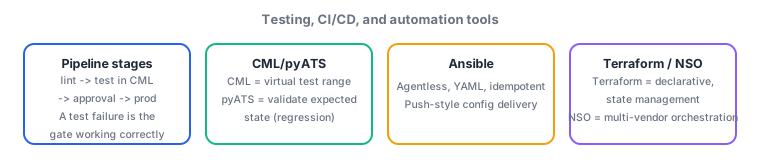
- CI/CD is a chain of gates
lint -> test in CML -> approval -> production -> post-verify; a failure at the test stage is the healthy act of stopping a misconfiguration before production - CML is a virtual test range to try changes safely before production; pyATS structures show output and validates expected state (regression detection)
- Choose tools by strength: Ansible (agentless/idempotent config delivery), Terraform (declarative/state-managed provisioning), NSO (multi-vendor service orchestration)
Sign in to track progress — Log in.
Quick check
(just a quick review)Q1. A CI/CD pipeline runs in the order `lint -> test in CML -> approval -> Ansible to production -> post-verify with pyATS`. A PR stops at the CML test stage after detecting "one site's BGP neighbor stays Idle." What is the most appropriate interpretation?
Q2. For a tool that distributes configuration to devices, you do not want a dedicated resident agent on targets and want to write the "desired state" in YAML and apply it idempotently over SSH/API. Which tool best fits?
Q3. Before and after applying a change, you want to mechanically validate expected state—"all BGP neighbors Established," "target interfaces up"—by structuring device show output, and detect unexpected degradation (regression). Which tool fits best?
Keep track of your progress
The full study guide is free to read. Sign up free to practice with the question bank, track what you have read, review your mistakes, and highlight passages.