

What's changed: In-scope coverage: added security (Macie/Inspector/Secrets Manager) to Ch4 §2 and governance/compliance/cost (CloudWatch/Config/Artifact/Audit Manager/Trusted Advisor/Well-Architected Tool/Cost Explorer/Budgets) to Ch4 §3
4.1Guidelines for Responsible AI
Understand responsible AI dimensions—fairness, explainability, transparency, privacy/safety, robustness—and addressing bias and hallucination.
AI is powerful but carries risks like bias, errors, and privacy harm. Responsible AI is guidance for using AI soundly while addressing these.
4.1.1Responsible AI dimensions
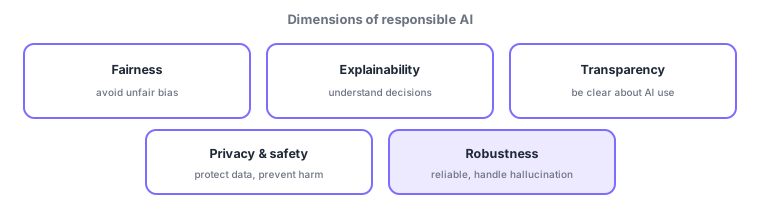
- Fairness: avoid unfair discrimination from biased training data (e.g., a hiring AI not biased by gender).
- Explainability: make the basis for outputs understandable. Transparency: disclose AI use and its capabilities/limits.
- Privacy & safety: protect personal data and prevent harmful/dangerous output.
- Robustness: operate reliably under unexpected input and address hallucination (plausible but wrong output).
Fairness gets special attention because AI bias arises from bias in the training data itself. If past hiring data skews toward certain attributes, an AI trained on it reproduces that skew—not malice, but faithfully learning the bias it was given. Hence the need for diverse, representative data and continuous evaluation/monitoring. In generative AI, hallucination—confidently producing plausible but wrong content—is a major risk; fluency does not equal correctness.
| Dimension | Meaning | Example mitigation |
|---|---|---|
| Fairness | Avoid unfair bias | Representative data, bias evaluation |
| Explainability/transparency | Understand basis, disclose AI | Show rationale, model cards |
| Privacy/safety | Protect data, prevent harm | Encryption, content filters |
| Robustness | Reliable, handle errors | Human review, RAG grounding |
Scenario: deploying a hiring-support AI. Check fairness on applicant data (no bias by gender/age), show recruiters the explainability of each rating, protect applicants’ privacy, ensure robustness against odd inputs, and transparency that AI is being used. One deployment involves several dimensions at once.
Watch the mix-ups: (1) fairness (avoid bias) vs explainability (understand the basis) vs transparency (disclose AI use). (2) Hallucination is dangerous because it is "confidently wrong"—fluency ≠ correctness. (3) Bias comes from training data; representativeness and evaluation are key.
Q. Explainability vs transparency? Explainability = "understand why an output was produced (basis)"; transparency = "disclose AI use and its capabilities/limits." Q. Why does bias arise? The model faithfully learns biased data; mitigate with diverse data and evaluation. Q. Can hallucination be eliminated? Not fully—mitigate operationally with RAG grounding and human review.
Common: avoid bias = fairness, understand the basis = explainability, disclose AI use = transparency, hallucination = plausible but wrong. Bias stems from training data; human review of generative output matters.
4.1.2Section summary
- Dimensions: fairness / explainability & transparency / privacy & safety / robustness
- Bias stems from training data → mitigate with diverse, representative data and ongoing evaluation
- Watch for hallucination in generative AI; reinforce with RAG and human review
Sign in to track progress — Log in.
Quick check
(just a quick review)Q1. Avoiding unfair discrimination from biased training data is which responsible AI dimension?
Q2. Making the basis for AI decisions understandable corresponds to which dimension?
Q3. What is it called when generative AI produces "plausible but factually wrong" content?
Keep track of your progress
The full study guide is free to read. Sign up free to practice with the question bank, track what you have read, review your mistakes, and highlight passages.