

What's changed: In-scope coverage: added a generative AI development and agent in-scope services block to Ch2 §2 (Kiro/Strands Agents/Amazon Bedrock AgentCore)
2.2AWS Generative AI Services
Understand AWS services for generative AI—Amazon Bedrock, Amazon Q, and Amazon SageMaker JumpStart—and when to use each.
AWS offers services to use generative AI without building your own model. Choose by "build into your app" vs "ready-to-use assistant."
2.2.1Key services
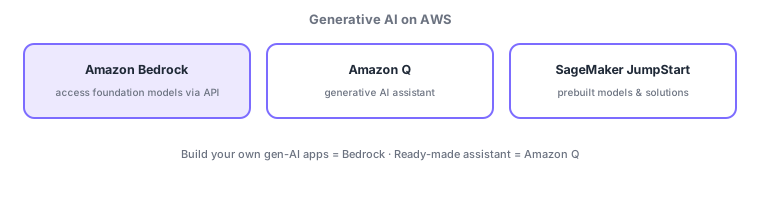
- Amazon Bedrock: a fully managed service to access foundation models from multiple providers (Anthropic, Amazon, Meta) via API and build generative AI into your apps; also offers RAG (knowledge bases), agents, fine-tuning, and guardrails.
- Amazon Q: a ready-to-use generative AI assistant for business and coding (Amazon Q Business / Amazon Q Developer).
- Amazon SageMaker JumpStart: quickly use, fine-tune, and deploy prebuilt models and solutions (more toward building your own).
- Amazon Bedrock Guardrails: safety controls to curb harmful input/output and off-topic responses in generative AI.
| Goal | AWS service |
|---|---|
| Build foundation models into your app via API | Amazon Bedrock |
| Ready-made business/coding assistant | Amazon Q |
| Try/fine-tune prebuilt models | SageMaker JumpStart |
| Answers grounded in your docs (RAG) | Bedrock Knowledge Bases |
| Curb harmful output | Bedrock Guardrails |
The axis is "build it vs use it now." To build a custom generative AI app, use Amazon Bedrock (foundation models via API). For ready-made help with business or coding without development, use Amazon Q. To try, fine-tune, and deploy prebuilt models yourself, use SageMaker JumpStart. This mirrors Azure’s "OpenAI Service (build) / Copilot (use now)."
Scenario: three choices. (1) Embed a custom chat feature into your app → Amazon Bedrock (foundation models + Knowledge Bases for RAG + Guardrails for safety). (2) A ready-made tool for employees to query internal data in natural language → Amazon Q Business. (3) A data scientist wants to try and fine-tune public models → SageMaker JumpStart.
Watch the mix-ups: (1) Bedrock (build foundation models into your app via API) vs Amazon Q (ready-made assistant). (2) Bedrock offers foundation models from multiple providers (not a single vendor). (3) RAG = Bedrock Knowledge Bases; safety = Guardrails. (4) These are for generative AI; Rekognition/Comprehend (previous chapter) are classic task-specific AI—a different category.
Q. Bedrock vs SageMaker JumpStart? Bedrock embeds foundation models into apps via API (no server management); JumpStart lets you try/fine-tune/deploy models yourself on SageMaker (more build-it). Q. Grounding on internal data in Bedrock? Use Knowledge Bases (RAG). Q. What can Amazon Q do? Q Business for internal-data Q&A, Q Developer for coding assistance.
Common: foundation models via API into your app = Amazon Bedrock, ready-made assistant = Amazon Q, try/fine-tune prebuilt = SageMaker JumpStart, RAG = Bedrock Knowledge Bases, safety = Guardrails. Bedrock offers foundation models from multiple providers.
2.2.2In-scope generative AI development and agent services
Beyond "using" generative AI, AIF-C01 also covers newer services for "building" it. Kiro is an AI-centric integrated development environment (an agentic IDE) that generates specs and code from natural-language intent to assist development. Strands Agents is an open-source framework/SDK for building AI agents in code—you can define a tool-using agent in a few lines. Amazon Bedrock AgentCore is a managed runtime to operate production agents securely at scale, providing agent memory, tool integration, gateways, and observability. It helps to line them up by how much you build: "Amazon Q Developer (ready-made coding help) → Kiro (agentic IDE) → Strands Agents (build agents yourself) → Amazon Bedrock AgentCore (production runtime)."
2.2.3Section summary
- Amazon Bedrock = foundation models via API into your apps (plus RAG/agents/Guardrails)
- Amazon Q = ready-made assistant, SageMaker JumpStart = try/fine-tune prebuilt models
- Axis: "build it (Bedrock/JumpStart) / use it now (Amazon Q)"
- Agent dev = Kiro (IDE) / Strands Agents (SDK) / Bedrock AgentCore (runtime)
Sign in to track progress — Log in.
Quick check
(just a quick review)Q1. Which AWS service provides API access to foundation models from multiple providers to build generative AI into your apps?
Q2. Which is AWS’s ready-to-use generative AI assistant for business and coding?
Q3. Which Amazon SageMaker feature lets you quickly use and fine-tune prebuilt models and solutions?
Keep track of your progress
The full study guide is free to read. Sign up free to practice with the question bank, track what you have read, review your mistakes, and highlight passages.