

What's changed: In-scope coverage: added a data/infrastructure in-scope services block to Ch1 §2 (Athena/Glue/EMR/Lake Formation/Redshift/OpenSearch/QuickSight/Data Exchange/Lambda/ECS/EKS/EC2/RDS/Aurora/ElastiCache/Neptune/DocumentDB/DynamoDB/CloudFront)
1.2ML Learning Styles and AWS AI/ML Services
Understand the three learning styles—supervised, unsupervised, reinforcement—and where AWS AI/ML services like Amazon SageMaker fit.
Machine learning splits into three styles by "how it learns." AWS provides managed services to support them.
1.2.1Three learning styles
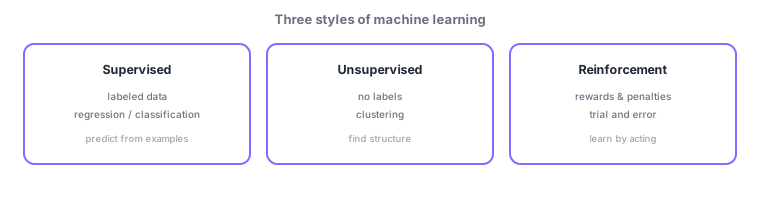
- Supervised: learn from labeled data—regression (number), classification (category).
- Unsupervised: find structure in unlabeled data—e.g., clustering.
- Reinforcement: learn behavior through trial and error via rewards and penalties.
| Style | Data | Typical task | Example |
|---|---|---|---|
| Supervised | Labeled | Regression, classification | Price prediction, spam |
| Unsupervised | Unlabeled | Clustering | Customer segmentation |
| Reinforcement | Rewards/penalties | Learn a policy | Robotics, games |
1.2.2AWS AI/ML services
AWS AI/ML services are easiest to remember in three layers by abstraction: (1) task-specific AI services (top, ready to use)—call pretrained models via API for images, text, speech; (2) Amazon SageMaker (middle, build your own)—an integrated environment to build/train/deploy ML models on your data; (3) ML frameworks/infrastructure (bottom)—run TensorFlow, etc. yourself. AIF-C01 focuses on (1) and (2): "generic tasks → prebuilt services / custom models → SageMaker."
- Amazon SageMaker: a managed environment to build, train, and deploy ML models end to end (custom models on your data).
- Amazon Rekognition: analyze images/video (objects, faces, moderation).
- Amazon Comprehend: analyze text (sentiment, entities, key phrases).
- Amazon Transcribe (speech→text) / Amazon Polly (text→speech) / Amazon Translate (translation) / Amazon Textract (extract text from documents).
- Amazon Lex: chatbots (conversational AI) / Amazon Kendra: intelligent search.
| Goal | AWS service |
|---|---|
| Build a custom model on your data | Amazon SageMaker |
| Analyze images/video | Amazon Rekognition |
| Text sentiment/entities | Amazon Comprehend |
| Transcribe / synthesize speech | Amazon Transcribe / Polly |
| Extract fields from documents | Amazon Textract |
| Build a chatbot | Amazon Lex |
Scenario: automating inquiries. Transcribe customer audio with Transcribe → analyze sentiment/points with Comprehend → respond via a Lex chatbot → optionally Translate and voice with Polly. For models prebuilt services lack (e.g., company-specific defect detection), build custom in SageMaker. Generic → prebuilt, custom → SageMaker.
Watch the mix-ups: (1) Tell learning styles apart by labels and rewards (labels = supervised / rewards = reinforcement / neither = unsupervised). (2) SageMaker (platform to build custom models) vs task-specific AI services (ready-made APIs, no training). (3) Rekognition = images, Comprehend = text, Transcribe = speech-to-text, Polly = text-to-speech.
Q. SageMaker or task-specific AI? Prebuilt AI services for generic tasks (common image/text/speech); SageMaker when you need a custom model (company-specific prediction/classification). Q. Quick supervised-vs-unsupervised check? With labels = supervised; without, finding structure = unsupervised. Q. Comprehend vs Translate? Comprehend "analyzes" text (sentiment, entities); Translate "translates" between languages.
Common: distinguishing supervised/unsupervised/reinforcement, and mapping custom model = SageMaker vs task-specific prebuilt AI = Rekognition (images)/Comprehend (text)/Transcribe·Polly (speech)/Translate (translation)/Textract (documents)/Lex (chatbots).
1.2.3In-scope data and infrastructure services
The foundation of AI/ML is data. AIF-C01 also tests analytics/data services. Serverless SQL over S3 is Amazon Athena, serverless ETL and a data catalog are AWS Glue (no-code prep is AWS Glue DataBrew), large distributed processing is Amazon EMR, and fine-grained data-lake permissions are AWS Lake Formation. Columnar analytics is Amazon Redshift, full-text/vector search is Amazon OpenSearch Service, visualization is Amazon QuickSight, and external data subscription is AWS Data Exchange. For runtime, use AWS Lambda (serverless), containers with Amazon Elastic Container Service / Amazon Elastic Kubernetes Service, and compute with Amazon EC2. Choose purpose-built data stores: Amazon RDS / Amazon Aurora (RDBMS), Amazon ElastiCache (low-latency cache), Amazon Neptune (graph), Amazon DocumentDB (document), Amazon DynamoDB (key-value), and Amazon CloudFront (delivery). For long-term retention, keep archival training data in low-cost Amazon S3 Glacier.
1.2.4Section summary
- Learning styles: supervised (labels) / unsupervised (structure) / reinforcement (rewards)
- SageMaker (build/train/deploy custom) / task-specific AI services (prebuilt APIs)
- Task-specific: Rekognition = images, Comprehend = text, Transcribe/Polly = speech, Translate = translation, Textract = documents, Lex = chatbots
- Data = Athena/Glue/EMR/Lake Formation/Redshift/OpenSearch; runtime = Lambda/ECS/EKS; stores = RDS/Aurora/DynamoDB and more
Sign in to track progress — Log in.
Quick check
(just a quick review)Q1. Which ML learning style learns behavior by trial and error via rewards and penalties?
Q2. Which AWS managed service builds, trains, and deploys ML models end to end?
Q3. Which task-specific AWS AI service fits analyzing images (detecting objects/labels)?
Keep track of your progress
The full study guide is free to read. Sign up free to practice with the question bank, track what you have read, review your mistakes, and highlight passages.